


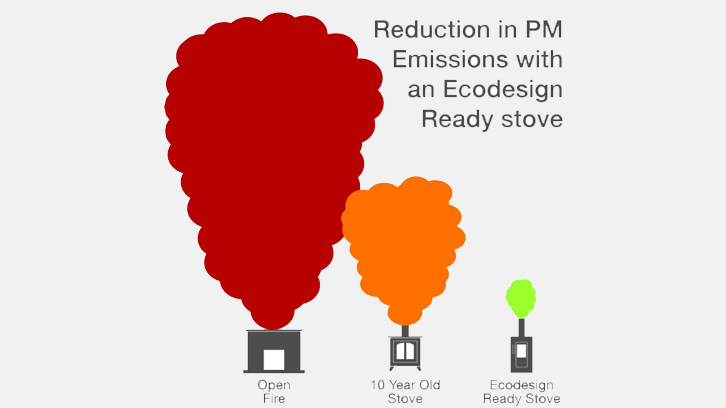
Ecodesign 2022 is a European standard concerning the minimum ecodesign requirements for stoves, fireplaces and general solid fuel heating products (wood, pellets, etc.). It became mandatory from 1 January 2022 in all EU Member States.
EU Directive 2015/1185 is the European Ecodesign Regulation for local solid fuel space heating appliances (such as fireplaces, wood/pellet stoves, cookers etc.) It is part of the wider Ecodesign Directive (2009/125/EC) which aims to reduce pollution and increase energy efficiency.
What does it practically mean?
In order for a stove or fireplace to be legally sold in Europe after 2022, it must meet certain limits on:
✅ Efficiency (at least 75% for wood-burning stoves, 85% for pellets)
❌ CO (carbon monoxide) emissions
❌ Particulate matter (PM)
❌ Organic volatile compounds (OGC)
❌ Nitrogen oxides (NOx)
Why is it important?
Environmental protection: Less pollution from old fireplaces/stoves. –
Economy: More heat with less wood. –
Legal: Prohibited from selling products that do not meet Ecodesign standards from 2022 onwards.
How do I recognize it?
Products that are Ecodesign 2022 certified are accompanied by.
- ✅ The specific Ecodesign 2022 limits (in mg/Nm³, with 13% O₂ in combustion):
| Device Category | CO (Monoxide) | PM (Particles) | OGC (Organic compounds) | NOx |
| Fireplace closed type (wood) | ≤ 1.5 g/m³ | ≤ 40 mg/m³ | ≤ 120 mg/m³ | ≤ 200 mg/m³ |
| Wood stove | ≤ 1.2 g/m³ | ≤ 40 mg/m³ | ≤ 120 mg/m³ | ≤ 200 mg/m³ |
| Pellet stove | ≤ 0.3 g/m³ | ≤ 20 mg/m³ | ≤ 30 mg/m³ | ≤ 200 mg/m³ |
- (limits may vary slightly depending on the country – above are the general European values)
Examples of national variations:
Germany (BImSchV – Stufe 2)
- There are much stricter emission limits than Ecodesign
- Mandatory regular inspection and replacement of old appliances.
- Many cities (such as Munich) completely ban wood stoves without filters.
France
- There is a Flamme Verte label, in addition to Ecodesign, which defines quality levels.
- Some regions impose local restrictions during periods of smog.
Sweden
- A policy to support biomass, but only in efficient heating systems.
- Very good public information on how to do combustion properly.
Italy
- In areas with high pollution (e.g. the River Pados) complete bans have been imposed on old fireplaces.
- Classification of appliances into 5 stars, with areas only allowing 4 or 5 stars.
Greece
- So far, there are no stricter national restrictions beyond Ecodesign
- There is no active system of inspection or replacement of old appliances.
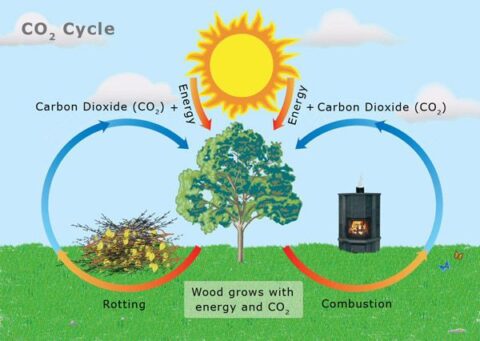
If you burn wood in a fireplace or let it decompose in the forest…
The ecological footprint in CO₂ is almost the same.
That is, the amount of carbon dioxide (CO₂) released into the atmosphere is almost equal to either:
- Burns (complete combustion)
- Decomposes naturally (aerobic decomposition)
- Why?
- Wood is a biogenic fuel:
During its growth, the tree absorbs CO₂ from the atmosphere through photosynthesis.
When it dies and decomposes or burns, this CO₂ is returned to the environment.
It is a natural carbon cycle.
❗ When does it become problematic?
✅ If combustion is efficient and controlled (e.g. in an Ecodesign fireplace): –
Mainly CO₂ is emitted
Few other polluting by-products
❌ If combustion is incomplete (old stoves, open fireplaces):
- Produces CO (monoxide), PM (particulate matter), carcinogenic compounds
Conclusion:
Burning wood in a modern Ecodesign-certified fireplace is considered climate neutral if the wood is sustainably managed.
The point is not whether it is burned, but how it is burned and where it comes from.
Is wood ecological? – The truth about CO₂ emissions:
- Wood combustion is part of the natural carbon cycle
- The ecological footprint is the same as decomposition
- Only incomplete combustion causes pollution
- Ecodesign certified appliances are CO₂ neutral